GLOSSARY
Prototyping voice agents
Our customer had high call volume, strict account verification, regional language needs, and an existing Talkdesk and Salesforce stack. We'd not yet branched our agent into Voice, so this was about quickly exploring how voice agents could/should work for Outverse.
The agent graph
In the interest of speed - we used ElevenLabs to power our prototype voice agents - it enabled me to get started immediately building out the agent graph and it's pathways.
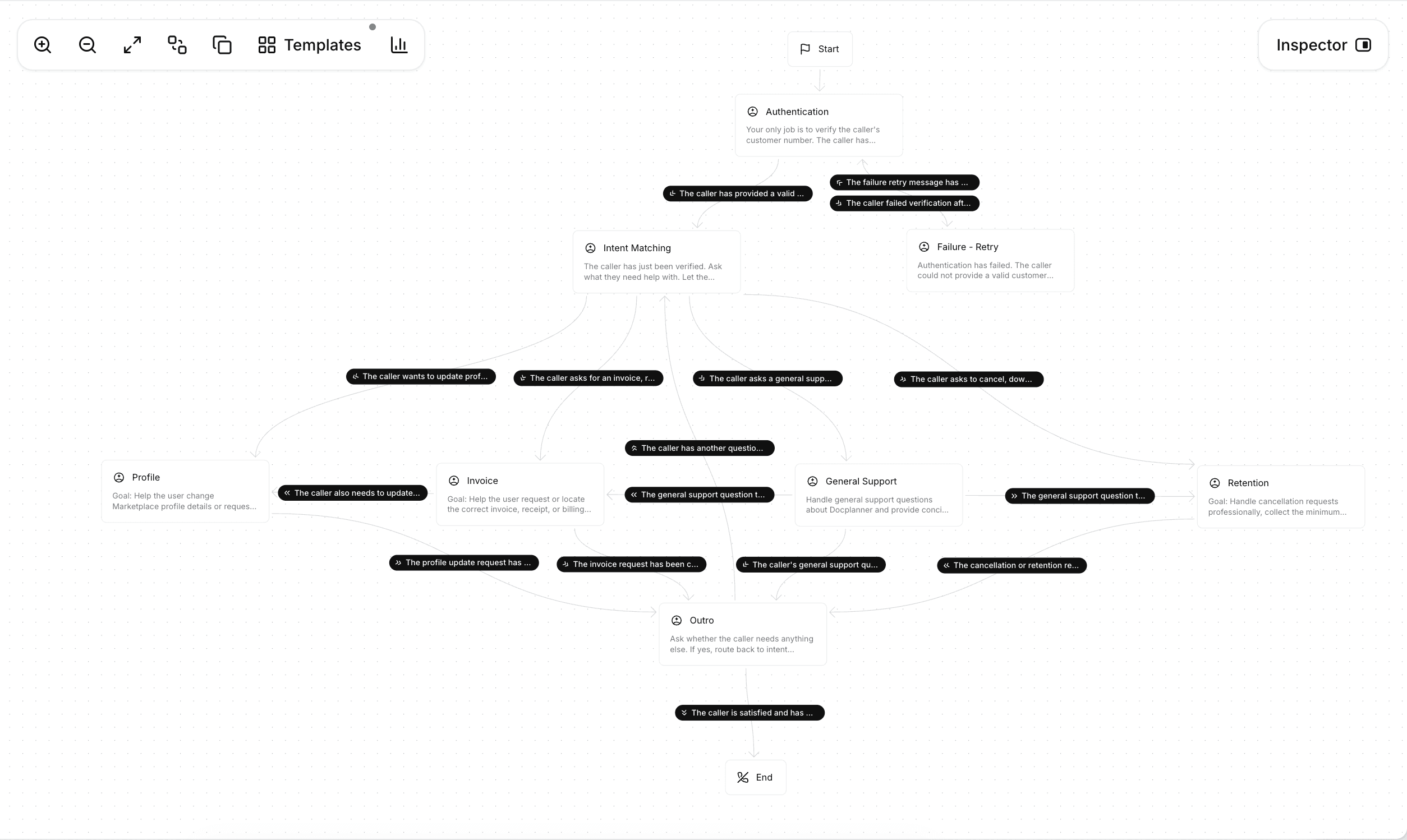
FIG 01 / GRAPH VIEW OF AGENT
Authentication - The agent authenticated callers by matching a name and ID against a mock Airtable DB via tool use. Verified callers could then ask their query and the agent would route depending on the intent.
General support - For general queries, the agent drew on an uploaded knowledge base of product docs to answer.
Invoice requests - Customers were often calling requesting invoices - whilst this was something they could self serve, we wanted to also equip the agent with the ability to look up the customers invoices, and if requested send it to them.
Downgrades/Cancellations - When the agent detected cancellation or downgrade intent, it routed to a retention pathway - letting the caller know it needed to transfer to a human, then handing off to Talkdesk.
Prototyping the interface
ElevenLabs powered the agent, but I wanted to explore how it would live inside Outverse. Their SDK @elevenlabs/react made this straightforward.
The sandbox let us start a call directly inside Outverse and talk to the voice agent in-browser. When the call ended, the API pulled the conversation into the history view — where the recording could be played back and the transcript, workflow events, routing decisions, and tool calls displayed inline. Full observability of every call, not just the audio.
FIG 02 / SURFACE FOR USERS TO START CALL / VIEW CALL HISTORY
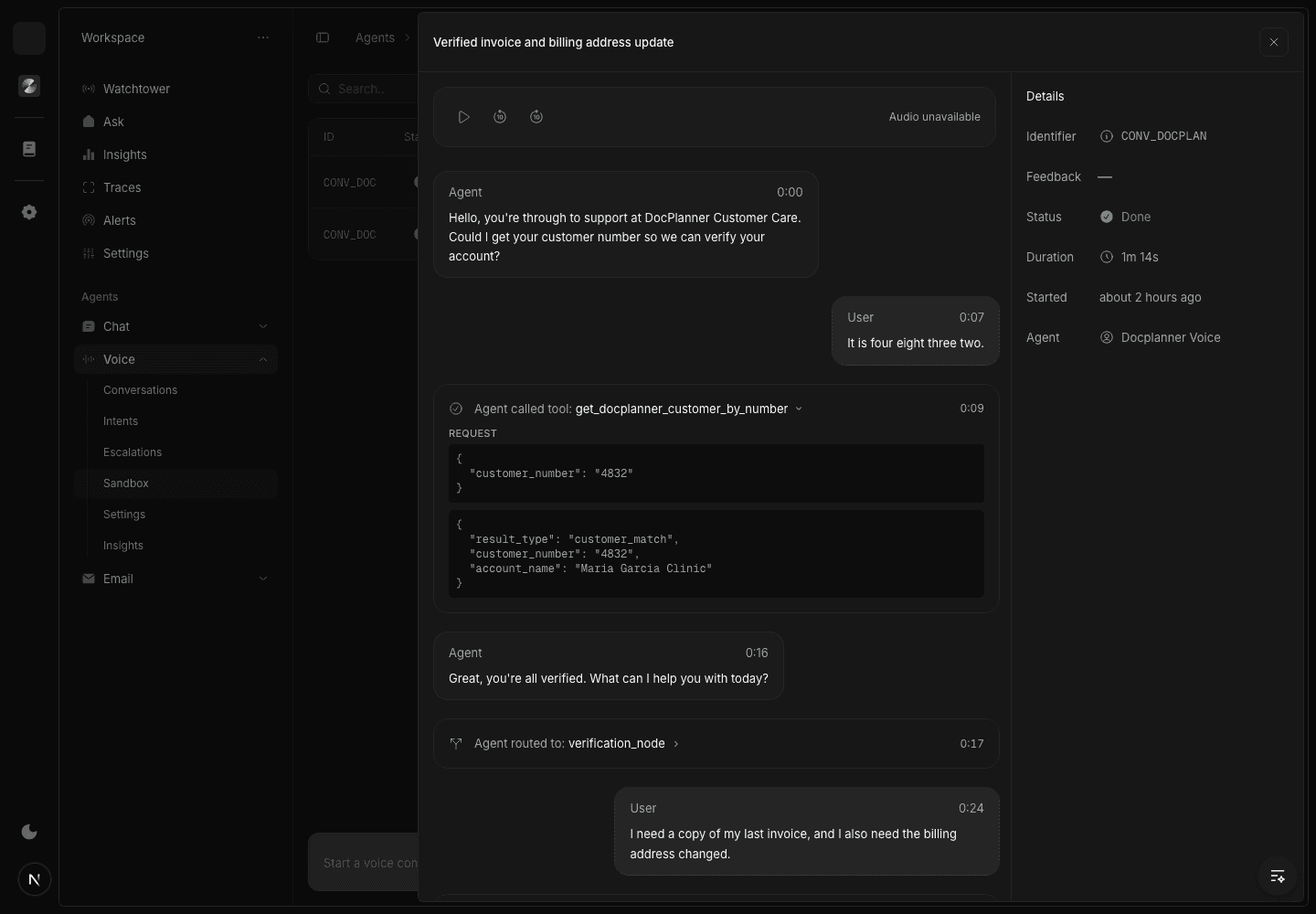
FIG 03 / A viewable call transcription
Using coding agents to iterate on the agents
ElevenLabs also has a CLI, which let me use Claude/Codex to pull my live agent config, simulate calls, and build a test-tweak-review loop programatically
Automating the demo pipeline
I built a Notion agent to automate the setup for new voice-agent demos. It used Firecrawl to pull details about a prospect company - their product, support docs, help center content - and synthesized that into a system instruction prompt.